September 2026
Are We Planning Our Own Death? The Uncomfortable Future of Medicine
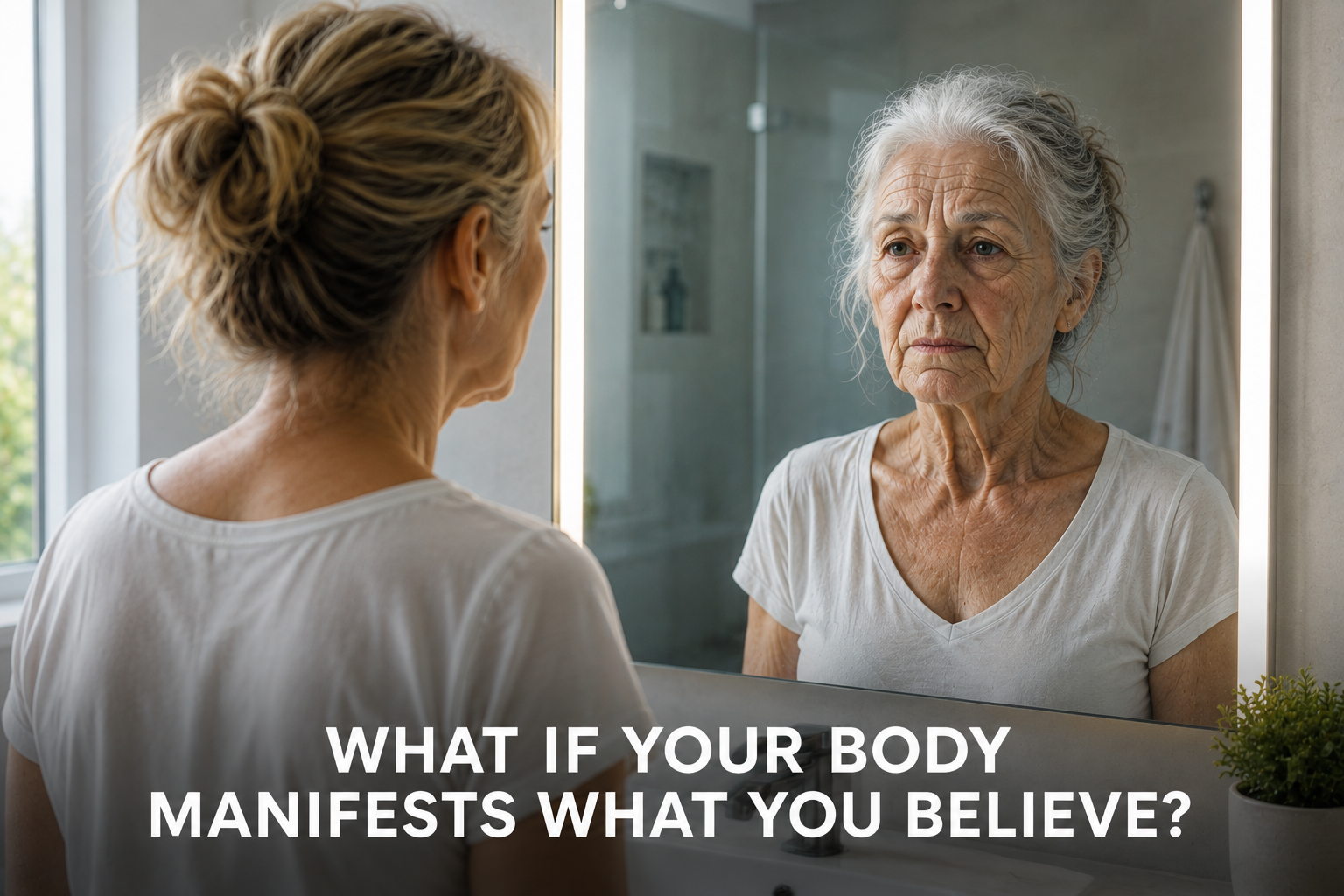
When someone close to me turned about 65, she bought a book about health, except it wasn't really a book so much as an encyclopaedia of everything that could possibly go wrong with a human body. She read the book from cover to cover and referred to it in all subsequent conversations; it became known in the family as ‘that bloody book’. Her partner noticed something at the time that I didn't fully appreciate until years later. Over the next seven years her health deteriorated steadily until she died at 72 from multiple conditions, and while I can't claim the book directly caused that; there was a noticeable change in mentality and something about the timing I've never quite been able to shake off. She had reached the age where the conversation about health changes shape entirely. Instead of simply living, she was suddenly being introduced, page by page, to everything that could go wrong with her. And then, not long after, things started going wrong.
Years later I came across a concept that made me look back at that whole period differently: the placebo effect, and its far more unsettling twin, the nocebo effect.
The Body Is Listening, Whether You Like It or Not
The placebo effect is one of those facts medicine has never quite been able to explain away, no matter how uncomfortable it makes the profession. Give someone an inert substance while convincing them it's real medicine, and under the right conditions, their symptoms improve — not because they're imagining it, but because placebo research has repeatedly shown measurable changes in pain perception, brain activity, neurotransmitters and other physiological processes. Expectation alone can produce a biological response.
The reverse is just as real, and arguably more disturbing. Tell someone a treatment might cause headaches, nausea or dizziness, and a significant number of people will develop exactly those symptoms — with zero active ingredient anywhere near them. That's the nocebo effect, and the numbers behind it are hard to dismiss.
In the SAMSON statin trial, 60 people who had previously quit statins because of side effects rotated between statin tablets, placebo tablets and no tablets at all. Their average symptom score sat at 8.0 with no tablets, 16.3 on the actual statin, and 15.4 on the placebo — meaning roughly 90% of the symptom burden people attributed to the drug was actually generated by belief alone. The symptoms were real. The suffering was real. The story people had been told about where that suffering came from was, in the majority of cases, simply wrong.
Not All Beliefs Carry the Same Weight
This is usually where the conversation politely stops, and I think that's a mistake. We accept, grudgingly, that expectation can move the body — fine — but almost nobody follows that thought to where it actually leads, because beliefs aren't interchangeable. A tiny sentence on the side of a pill packet reading "may cause headaches" carries a certain weight; you read it once, maybe notice a headache later, and move on. Now compare that to a belief drilled into you from childhood by parents, teachers, doctors, governments, newspapers, television and every advertisement you've ever half-watched: smoking causes cancer. That isn't a warning label. That's an entire psychological architecture, reinforced thousands of times over a lifetime, wired into statistics, photographs, funerals and personal stories until it stops being an idea and becomes part of how you understand reality itself.
So, if expectation can move physiology at the scale of a warning label, why would anyone assume that scale doesn't matter — that a lifetime of repetition produces no more effect than a single sentence? It doesn't hold up, and placebo research itself points the other way: conditioning, prior experience, social reinforcement and verbal suggestion all deepen the response, and stronger conditioning produces stronger effects. The mind clearly influences the body. The only real question left is how far that influence actually reaches.
Where Does This Stop?
If a belief can shift a symptom, could a big enough belief shift an actual disease process? If repeated expectation can alter physiological response in a lab over weeks, what happens after decades of being told, in a thousand different ways, exactly what happens to a body at 40, 50, 60 and 70? We already know brain and body aren't running on separate operating systems — stress rewrites hormones, fear resets heart rate, expectation reshapes perception, and conditioning measurably shifts immune and hormonal function. None of that is mystical. It runs straight through the nervous system, the endocrine system and the immune system, using pathways we can already name.
And then you arrive at epigenetics, which is where the ground genuinely starts to shift.
Your Genes Are Not a Fixed Script
Your DNA sequence was never the closed instruction manual we were taught it was. Cells constantly decide which genes get switched on and which get silenced, through mechanisms like DNA methylation and histone modification, and — critically — those mechanisms respond to the environment around them. Stress is one of the clearest examples: a review of 217 studies found extensive links between psychological stress and changes in DNA methylation, though the same review was honest enough to flag serious problems with reproducibility across that research. A 2026 longitudinal study of 69 healthy adults went further, identifying associations between chronic psychological stress and changes across 956 separate CpG sites. Researchers have even begun asking whether psychological interventions themselves can shift methylation patterns — a recent scoping review of 21 human studies found several reporting changes in genes tied to stress and inflammation.
To be clear, none of this proves that believing "I am healthy" rewrites your DNA. That would be overselling early, contested research, and I'm not going to pretend otherwise. What it does do is demolish the comfortable idea that mind and body are running two completely separate shows. The environment talks to the genome. The brain talks to the body. The body talks back. And that conversation never actually stops.
What Happens When We Hand People a Roadmap to Their Own Decline?
This is the question that keeps pulling me back. Modern medicine has become extraordinarily precise at identifying risk — you can calculate your cardiovascular probability, uncover genetic predispositions, learn exactly what killed your parents and grandparents, and now monitor your own body in real time, every hour of every day. All of this can save lives. But it also does something else, quietly, in the background: it hands people a script for what to expect from their own bodies, and scripts have a way of getting performed.
What happens inside the head of a 50-year-old who starts thinking, "my father had a heart attack at 62, so that's probably coming for me too"? What happens after years of being told, "at your age, this is just normal"? What happens when ageing itself is presented as nothing but an inevitable catalogue of breakdowns, ticked off one by one? Maybe none of it matters beyond nudging behaviour slightly. Or maybe we've badly underestimated what expectation is capable of doing to a body over decades — and if there's a real chance of that, it deserves to be taken seriously, not as an argument against medicine, but as a question medicine should actually want answered.
And Here's the Part Nobody Really Wants to Even Think About
If research eventually shows that deeply held beliefs can shape long-term physiological outcomes on a scale well beyond the placebo effects we already accept, the implications are enormous — because it would mean healthcare isn't only treating disease, it may also be quietly helping construct the psychological climate in which that disease takes hold. And that's an uncomfortable thing to say out loud, for an obvious reason: an entire global industry has been built around diagnosing, managing and treating illness. Millions of careers sit inside it. Companies profit enormously from it. Hospitals are structured around it. Governments organise policy and budgets around it.
But the resistance won't come only from the industry. It will come from the rest of us too, and for reasons most people won't admit even to themselves. Suggest to someone that their condition might be connected to a lifetime of belief, expectation and conditioning, and watch how fast the conversation turns hostile. Nobody wants to hear it, and the reaction rarely has much to do with the evidence. It has to do with what the idea seems to take away: the comfort of being a victim of circumstance rather than a participant in the outcome. Bad luck asks nothing of you. Bad genes ask nothing of you. A mind that may have played a role in shaping the body's decline asks something far harder — it asks you to look at your own thinking, your own fears, your own decades of quiet self-talk, and wonder what part you played.
Most people would rather not know. An explanation that removes all responsibility is more comfortable than one that hands some of it back, and so we end up with two forces reinforcing the same silence from opposite directions — an industry with every incentive to leave the idea unexamined, and a public with every emotional incentive to leave it unexamined too. Neither side is lying, exactly. Both simply find it easier not to look.
Perhaps the biggest revolution left in medicine won't arrive in a syringe or a pill bottle. Perhaps it will come from finally admitting that the patient isn't just the body on the table — the patient is the mind running that body, uncomfortable as that is for institutions and individuals alike. And if that mind turns out to carry far more weight than we've been willing to admit, the real question isn't whether traditional medicine disappears. It's whether we're capable, as a species, of trading the comfort of a ready-made excuse for the harder, stranger work of understanding what we've actually been doing to ourselves all along.
Ready to do it the smart way?
Start practicing today with the Oxbridge English translator and turn every translation into a real lesson.
View Courses Try SmarTranslator