Septiembre 2026
The Exponential Curve: Why We Always Think We Are Here
I was recently having a conversation with some older relatives about young people and technology, and their concerns were the familiar ones you've probably heard a hundred times yourself: young people spend too much time glued to their phones, they don't communicate properly anymore, everything is changing far too quickly, and what on earth is the world going to look like by the time they're old.
I listened, and I largely agreed, because it's genuinely difficult not to — the pace of technological change really does feel extraordinary from where we're standing.
But then something occurred to me. When I was young, back around 1980, I had almost exactly the same conversation, except with the roles reversed. I was the kid in question. Only back then there was no social media, no smartphone, no AI to point to. There was the Sony Walkman, and I distinctly remember adults talking about it as though civilisation itself were quietly unravelling. Young people walking around with headphones clamped to their ears, cut off from the world, turning into some kind of antisocial zombie generation — technology was reshaping how young people behaved, and nobody seemed entirely sure where it would end.
Watch the clip from the movie 'Super 8' set in 1979: https://www.youtube.com/watch?v=AVnzivdEXWs
At the time, naturally, I assumed these adults simply didn't understand the modern world. Now, rather uncomfortably, I've become one of them. And that's what set me wondering: what if this isn't a modern phenomenon at all, but something we've been doing to ourselves for centuries?
Imagine Going Back to Napoleon's Time
Picture travelling back to Europe around 1800. There are no smartphones, no computers, no aeroplanes — most people are still getting around by horse, carriage or ship. And yet ships are becoming faster and more sophisticated by the year, new engineering techniques are appearing seemingly out of nowhere, industrialisation is beginning its slow transformation of production, and the steam engine is quietly rewriting what's even considered possible.
Now imagine sitting in a room with some elderly people from that period, and they turn to you and say something like: "Everything is changing so quickly these days. Young people simply don't understand how different the world is becoming. These new machines are going to change absolutely everything — where will it end?"
They'd probably be right, at least from where they were standing. Development, from their vantage point, really was accelerating. But if we look back at that same period from where we sit in 2026, it appears almost like a flat line on the graph compared to everything that came afterwards. And that, it turns out, is the peculiar thing about an exponential curve.
We Always Think We're at the X
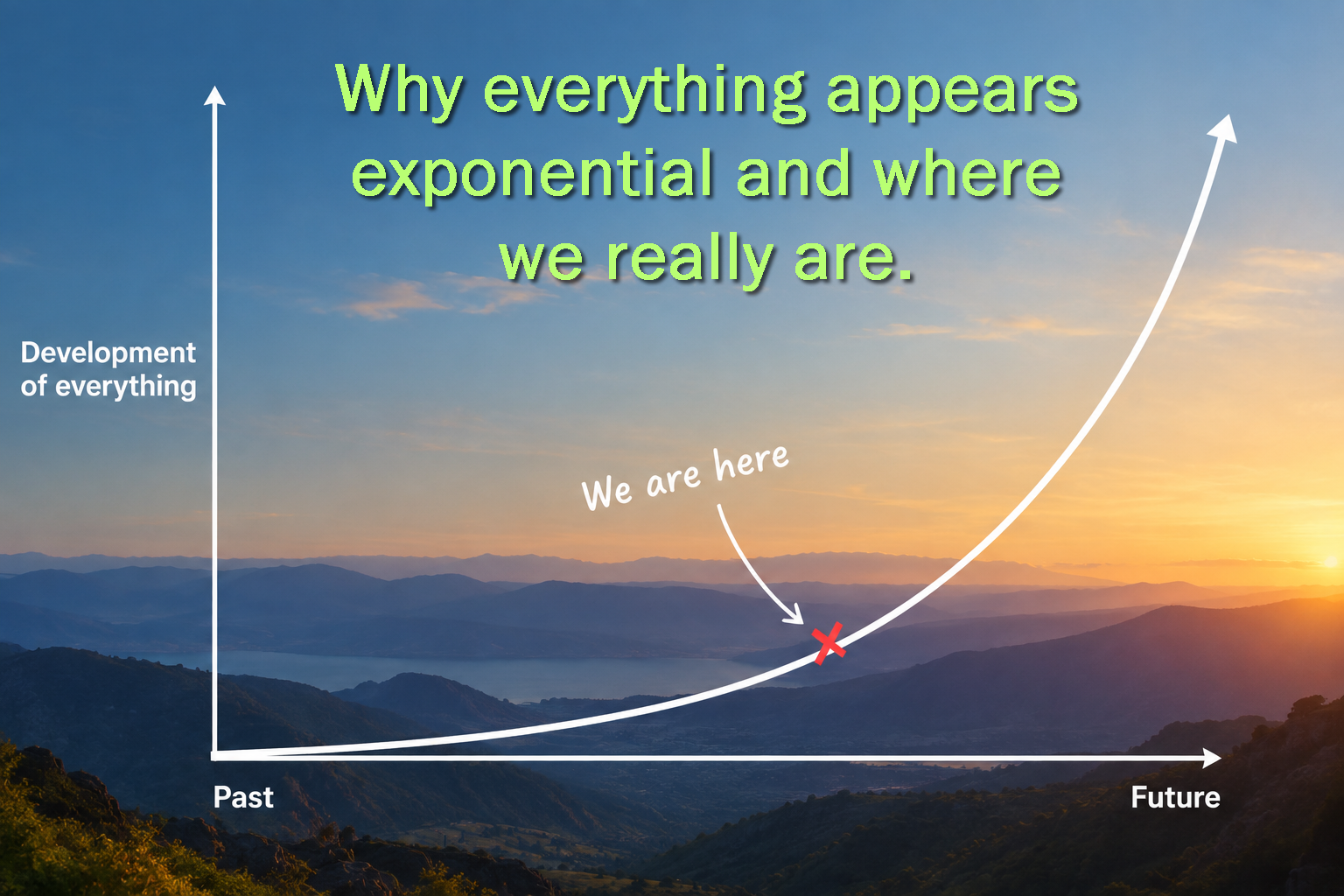
Picture an exponential curve drawn on a graph. The horizontal axis represents time, with the past stretching away to the left and the future opening up to the right. The vertical axis represents development in the broadest possible sense — knowledge, technology, communication, transportation, medicine, computing, productivity, all the accumulated human effort we keep building on top of.
Now imagine placing an X somewhere on that curve, with a little label pointing to it that says WE ARE HERE. That's where every single generation, without exception, sincerely believes it stands. The generation living through the Napoleonic era looked at the changes swirling around them and thought, quite reasonably, we are here. My generation looked at the Walkman, the television, the earliest personal computers and the first flickers of the internet, and thought exactly the same thing. Today we look at smartphones, social media, biotechnology and artificial intelligence and think, once again, we are here. And our grandchildren, whatever their world ends up looking like, will almost certainly sit somewhere and say precisely the same thing all over again.
So, if every single generation believes it occupies the same position on the curve, how could the curve possibly be moving forward at all? The answer, as it turns out, is that our position along the horizontal axis isn't really what's changing in the way we instinctively imagine — what's actually shifting, generation after generation, is our value on the vertical axis.
We Move Up, Not Along
This is the part that's so easy to miss, because we naturally picture ourselves travelling along the horizontal axis of time — yesterday leads to today, which leads to tomorrow, in a nice tidy line. But if development itself behaves exponentially, then as we move forward through time, the change that actually matters isn't our horizontal position at all. It's our vertical one.
We're continually being lifted to a higher point of development, even while it feels, from the inside, like we're simply walking forward in a straight line. Someone living in 1800 experienced the world at their own particular level of development and genuinely believed things were accelerating. Someone living in 1980 experienced a substantially higher level of development and believed exactly the same thing. We experience an even higher level today, and — you'll notice the pattern — we believe precisely the same thing too.
None of them were wrong, exactly. They weren't mistaken about their own lived experience of acceleration. Where they went astray was in assuming that the particular rate of change they happened to be witnessing was somehow the maximum, or the permanent, speed of the whole system.
Nature Has Been Doing This for a Very Long Time
None of this, incidentally, was invented by technology — nature has been running this exact playbook for billions of years, and gives us some genuinely spectacular examples of exponential processes if you know where to look. Take bacteria: one divides into two, those two become four, four become eight, eight become sixteen. At the start, nothing about this looks remotely dramatic. But let enough generations pass, and the numbers involved become almost incomprehensibly enormous, seemingly out of nowhere.
The strange thing is that if you happened to be watching the process unfold at any single moment along the way, you'd almost certainly think to yourself, "ah, so this is roughly how fast things grow" — with absolutely no intuitive feel for how dramatically different the curve is going to look further down the line. Epidemics tend to behave in much the same way: if each infected person passes the infection on to several others, the total number of cases can look almost trivially small right up until it suddenly, and rather alarmingly, isn't. And then, at the more extreme end of things, there's a nuclear chain reaction, where one event triggers more events, which in turn trigger still more — the defining feature in every one of these cases being the same: the output of the process becomes part of the mechanism that generates the next round of output.
Which, as it happens, is also exactly what happens with human knowledge.
Knowledge Compounds
No invention vanishes when its inventor dies — it becomes the starting point for the next one. The steam engine fed industrial machinery, which fed mass production, which fed modern engineering. Electronics built on engineering, computers on electronics, the internet on computers, smartphones on the internet. The key word is cumulative. Each generation inherits the accumulated knowledge of thousands before it, building on a wall already remarkably tall — often without realizing its height. This is why exponential development feels so strange to live through.
We Experience Time in a Straight Line
We live one day at a time. Tomorrow looks broadly like today, next week like this week. Our personal experience of time feels linear, even while the larger systems we inhabit develop non-linearly. A child born today grows up inside a technological environment built on everything before their birth — but experiences only the result, as though it had always been there. That's why every generation eventually mutters that things are changing too quickly. The Walkman generation felt the same about technology; the generation before them felt it about television, radio, and the motor car. People in the Napoleonic era couldn't know their revolutionary developments would later look like just another flat stretch of the graph.
So Where Are We, Really?
The humbling truth: we don't know where we sit on the curve — only where we sit on the vertical axis. We can see enormous development behind us and feel rapid change around us, but we can't know how steep the curve will become, because the future is being built from the knowledge we're accumulating right now. Our descendants may look back at 2026 the way we look back at 1800 — amused that we thought we were living through such extraordinary change. Perhaps the real constant in human history was never the technology itself, but the human reaction to it. Every generation believes it has reached the peak. Every generation believes change is faster than ever. And in a strange sense, every one of them is probably right.
¿Listo para hacerlo de forma inteligente?
Empieza a practicar hoy con el traductor de Oxbridge English y convierte cada traducción en una lección real.
Ver Cursos Probar SmarTranslator