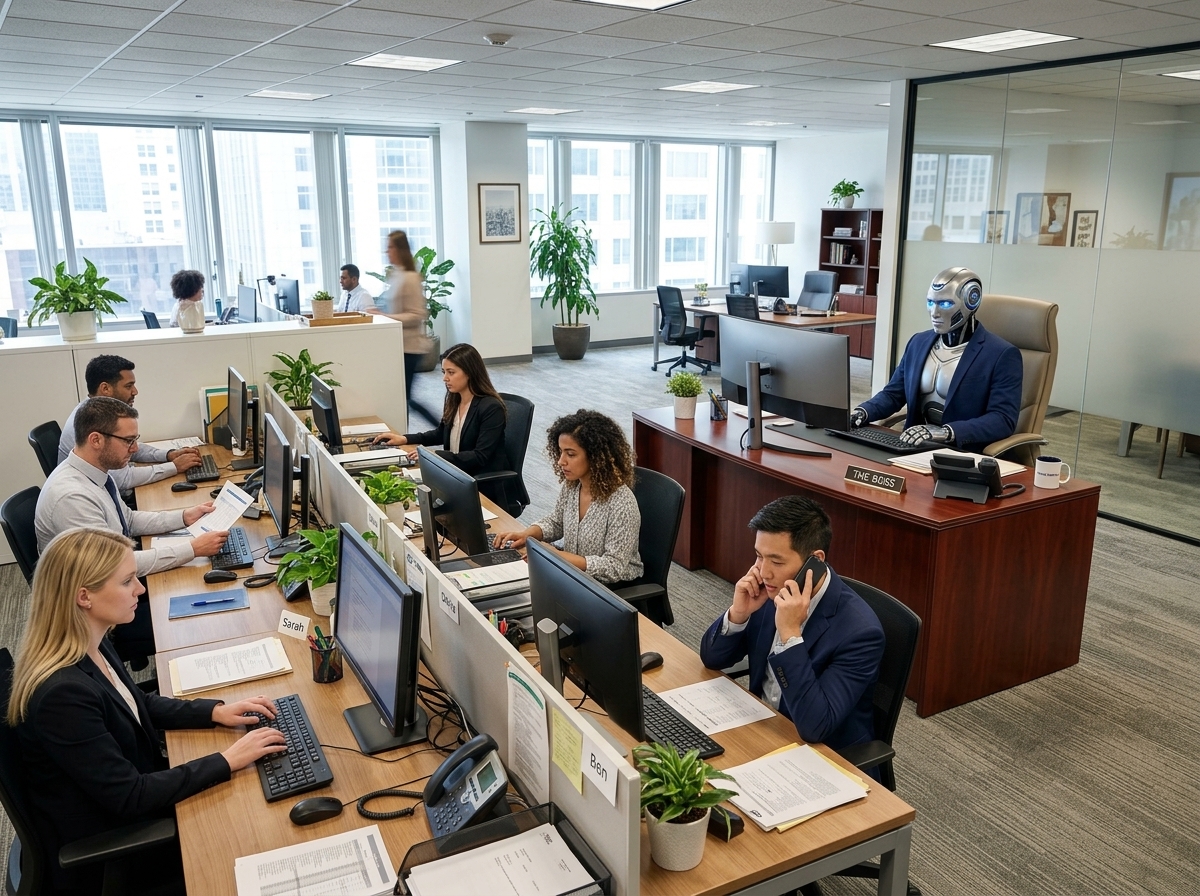
September 2026
The New Boss Doesn't Sleep, Doesn't Forget, and Doesn't Care About Your Excuses
Ken was my first real boss. He ran a small IT department in the early 90s, and he was — to put it generously — a man of appetites. He liked flattery, he liked loyalty, and he liked the particular kind of performance that has nothing to do with competence and everything to do with making him feel important.
Ken's world was simple. The people who got ahead were the ones who laughed at his jokes, agreed with him in meetings, stayed late when he was watching, and brought him coffee without being asked. It wasn't about the quality of your work — it was about whether you were willing to sell your soul, or whether you were a good enough actor to fake it convincingly. If you weren't good at that, if you were the kind of person who just wanted to do the job well and go home, you were overlooked, regardless of how smart you were or how much you actually contributed. You were invisible.
I was never good at that game. I couldn't do the performance, and I watched, year after year, as people who were objectively worse at their jobs got promoted past me simply because they knew how to make Ken feel like the smartest man in the room.
I'm telling you this because a growing number of workers are now walking into offices — or logging into laptops from their kitchen tables — to be managed not by a Ken, but by something that doesn't respond to flattery, doesn't get tired, and doesn't forget what happened last Tuesday. Something that doesn't give anyone a promotion because they laughed at the right joke at the right moment. This is the quiet revolution nobody quite agreed to have a proper conversation about.
The Question Has Changed
For years, the dominant question around artificial intelligence and employment was blunt and slightly terrifying: will it take my job? That question hasn't gone away, but it has been joined, rather stealthily, by a second and arguably more interesting one — even if AI doesn't take my job, will it fundamentally change what my job feels like to do? Will it change how I'm evaluated, how I'm trusted, what I'm expected to measure, and whether the invisible agreement I thought I had with my employer still means anything at all when the entity assessing my performance is an algorithm rather than a person who might, on a good day, cut me some slack over a coffee?
This isn't some distant science-fiction scenario. Algorithmic management is already being used to support or automate tasks such as monitoring, scheduling, performance management and the allocation of work. An OECD survey published in 2025 found that algorithmic management tools were already widely used across the six countries it studied, although the type and intensity of use varied considerably, and managers also reported concerns about things such as unclear accountability, lack of explainability and the protection of workers' health.
Psychologists have a name for part of the invisible agreement between employer and employee: they call it the psychological contract, the collection of mutual, largely unspoken expectations that exists underneath the actual legal contract that nobody ever reads properly anyway. You expect your employer to treat you reasonably, and they expect you to do your job properly. You expect some degree of human judgement, and they expect some degree of loyalty. You expect that if something goes wrong, you can explain yourself, and they expect that you're not going to take the piss.
The interesting thing about algorithmic management is that it can alter those expectations without anybody ever formally announcing that the rules have changed. The manager hasn't necessarily become less fair — the manager has simply been partially replaced by a system that operates according to a different logic, and that changes the emotional texture of work.
The Age of the Manipulator May Be Coming to an End
For decades, the advice we gave people on how to get ahead was essentially about managing impressions: be visible, be charming, laugh at the boss's jokes even when — especially when — they weren't remotely funny, linger by the coffee machine at the right moment, and make sure Ken saw you staying twenty minutes late, even if you spent nineteen of those minutes texting your friend about the game. Impression management, the academics call it, and it worked beautifully, because Ken was a human being with human weaknesses, and human weaknesses can be gently, cheerfully exploited by anyone with a bit of charm and enough self-awareness to know when they're doing it.
Try that on an algorithm and you'll get precisely nowhere. You cannot flatter a machine, you cannot make it feel guilty about giving you a bad review by mentioning, pointedly, that you've got a mortgage now, and you cannot corner it by the copy machine and quietly remind it that you covered for Steve that one time he had food poisoning. The algorithm doesn't remember your birthday, it doesn't care that you brought doughnuts in on Fridays, and it won't be moved, even slightly, by the fact that you once stayed until midnight fixing something that wasn't technically your responsibility — unless that effort was captured somewhere in the data it's actually looking at.
And that last part is crucial, because this is where the game changes. The age of the manipulator may be coming to an end. The person who gets ahead primarily by managing perceptions rather than doing the work — the smooth talker, the office politician, the person who always seems to be in the right place at the right time — may eventually lose some of that advantage when decisions become increasingly data-driven.
Under algorithmic management, being valued can become a question of legibility. Your output leaves a digital footprint, your deadlines can be measured, your response times can be recorded, your sales can be counted, your targets can be tracked, and your behaviour can be turned into data. The person who quietly does excellent work but never says a word about it in the meeting used to risk losing out to the loud, confident mediocrity standing next to them, and a system that measures actual output could, in theory, reverse some of that dynamic. The machine doesn't care who spoke loudest in the meeting — it cares about whatever the system has been designed to measure.
And that is both the attraction and the danger, because what cannot be measured can easily become invisible. If helping a colleague isn't recorded, it may not count. If mentoring someone doesn't improve a performance metric, it may disappear. If calming an angry customer prevents a problem that never becomes a complaint, there may be no data showing that you did anything at all. The algorithm may be less interested in how well you perform loyalty, but it may also be less capable of recognising the things that humans notice instinctively.
For those of us who were never good at the Ken game, there is something genuinely appealing about that — a kind of justice, a world where what you actually do matters more than how well you perform your loyalty to the person in charge. But there is a problem.
Algorithms Don't Eliminate Bias. They Move It.
It is tempting to imagine that replacing a human manager with an algorithm removes human bias, but it doesn't — it can simply move the bias somewhere else. Ken's biases were visible. You could see who his favourites were, you could see what he valued, and you could even, if you chose, play the game. With an algorithm, the important decisions may be hidden in the design of the system itself: what data is being collected, which behaviours count, which targets have been chosen, what is considered a successful outcome, which variables are treated as important, and what has been left out.
An algorithm doesn't wake up one morning and decide that it doesn't like you, but the people who design, train and deploy it make choices about what the system should measure and how those measurements should be interpreted, and those choices can produce unfair outcomes even when the system itself appears completely objective. Recent research into algorithmic HR management highlights precisely these concerns: transparency, fairness, accountability, privacy and human agency are becoming central issues as algorithms move further into recruitment, performance management and employee relations.
So perhaps the real comparison isn't human manager equals biased, algorithm equals objective. It is more complicated than that — perhaps it is human manager equals visible bias, algorithm equals potentially invisible bias, and that distinction matters, because you can argue with Ken. You can ask him why Steve got the promotion, you can point out that Steve didn't actually do the work, and you can appeal to his sense of fairness, however questionable that sense might be. What do you do when the answer is simply "the system determined your score"? That is a very different kind of authority.
But What Happens to Us?
And yet, there's always a catch, and the deeper question is one I don't think we've really answered: if the age of the manipulator ends, what happens to the rest of us?
The human personality isn't a fixed thing we carry around unchanged from birth to death. It is shaped, constantly and quietly, by the world we're trying to survive in. The skills that get rewarded get practised, the traits that get punished get suppressed, and we become, over time, whatever the environment demands we become. So what happens if we spend our working lives being evaluated by systems that value consistency, legibility and measurable output? What happens to the parts of us that don't fit neatly into those categories — the charm, the spontaneity, the ability to read a room, the willingness to do something generous that nobody will ever see, the instinct to help a colleague not because it will show up in a performance review, but because it's the decent thing to do, and the strange human ability to recognise that sometimes the right thing to do isn't the most efficient thing to do?
These qualities are difficult to quantify, and what is difficult to quantify can become difficult to reward. That doesn't necessarily mean they disappear, but environments shape behaviour, and if the system consistently rewards certain behaviours and ignores others, people will naturally learn to optimise for the things that count. This is not a new phenomenon — schools do it, companies do it, governments do it, and markets do it. The difference is that AI may make the feedback loop faster, more constant and far more detailed.
So the question becomes what happens to our personalities when the boss is a machine. Do we become more like the machine — reliable, predictable, optimised? Do we quietly sand down the rough edges of who we are until we fit neatly into whatever categories the system can measure? Or do we find ways to keep the messy human parts alive in the spaces the algorithm doesn't reach? I don't know the answer, but I think it's worth asking, because the question isn't really about AI anymore. It's about what we're willing to let it make of us.
A Different Kind of Skill
Maybe the real skill of the next decade isn't charming your boss, human or otherwise. Maybe it's learning how to remain valuable in a world where more and more of your value is being measured by machines. That doesn't mean becoming machine-like — quite the opposite. It may mean becoming better at the things machines struggle to understand properly: judgement, context, curiosity, empathy, creativity, and knowing when the numbers are telling you something important, as well as knowing when they're missing the point entirely.
And perhaps, just maybe, the end of the manipulator is a good thing — a chance to build a working world where what you actually do matters more than how well you perform, where quiet competence has a better chance of being recognised, and where the person who doesn't play office politics doesn't automatically lose to the person who does. But only if we're careful, because there is a very real danger in building systems that reward only what they can see. The goal isn't to become the algorithm. It's to make the algorithm see what's worth seeing in us, and that means keeping humans involved — not because humans are automatically better at making decisions, since Ken certainly wasn't, but because there are some things about being human that shouldn't have to prove their value by first becoming data.
Ken would never have given you a straight answer about what good work looked like either. At least you can try asking the algorithm.
Further Reading
OECD — How widespread is algorithmic management in workplaces? Research into how businesses are using algorithmic management and the concerns managers themselves have about accountability, explainability and employee health. https://www.oecd.org/en/publications/how-widespread-is-algorithmic-management-in-workplaces_cda7a114-en.html
Nature — Algorithmic management and the future of work Research examining some of the questions surrounding fairness, transparency, accountability and human agency as algorithms become more involved in workplace decisions. https://www.nature.com/articles/s41599-026-06989-4
Ready to do it the smart way?
Start practicing today with the Oxbridge English translator and turn every translation into a real lesson.
View Courses Try SmarTranslator