October 2026
To Give or Not to Give, That is the Question
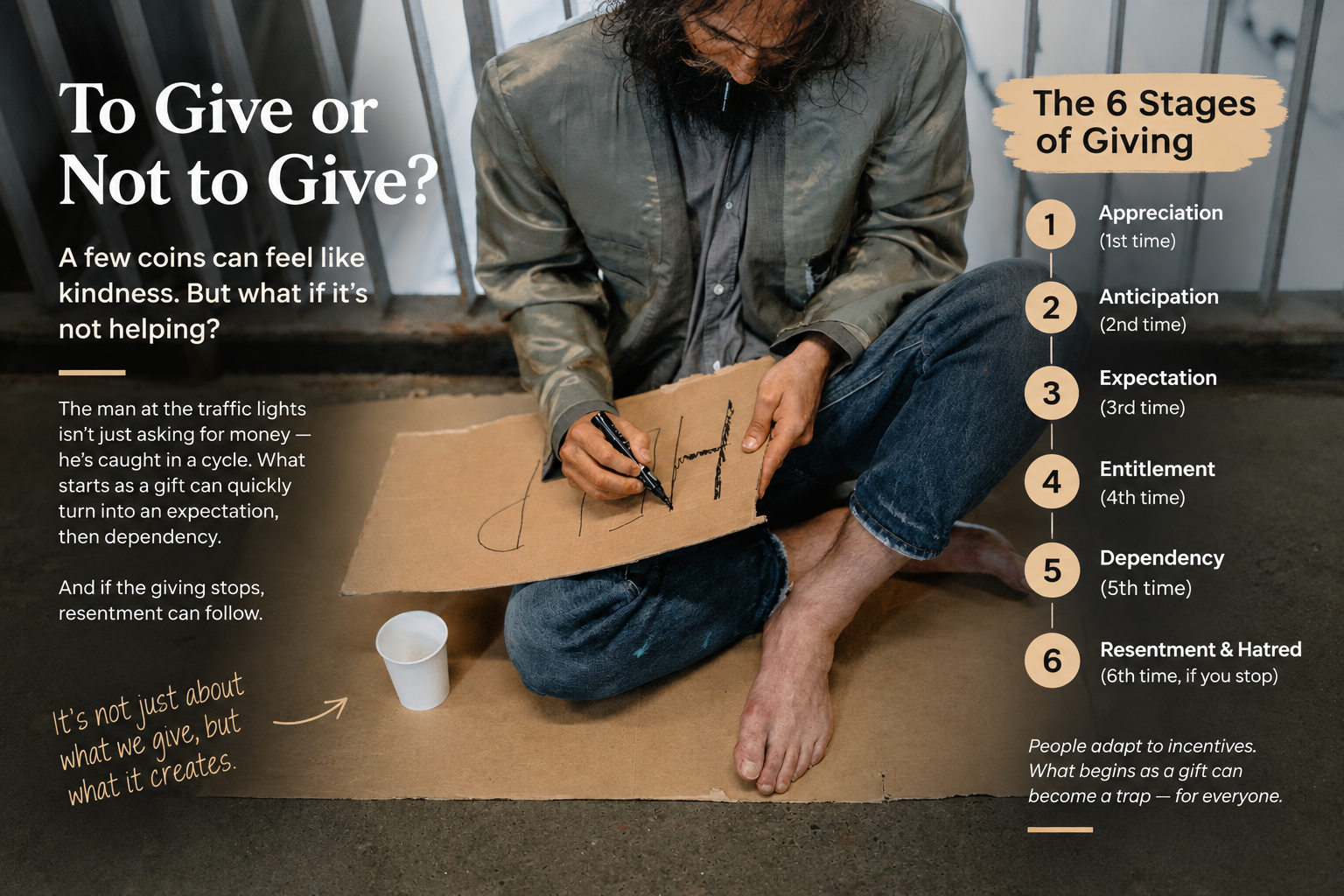
A few years ago I was talking with a friend about a man we both knew by sight at one of the traffic lights here in Colombia, a regular fixture with obvious mental-health and drug problems who would now and then attempt some dismal juggling for the benefit of the drivers waiting for the light to change. It was plain to anyone watching that he was in serious trouble, and the reflex of most people, was to wind down the window and hand over a few coins, on the perfectly reasonable grounds that he was clearly worse off than they were and that they had change to spare. My friend, who has never been troubled by an excess of sentimentality, made the opposite case with a bluntness I found surprising at the time and have found harder to dismiss with every year since: what the man needed was to get clean and put his life in order, which is impossible while he is standing at a traffic light, and there is exactly one way to guarantee that he will be standing there again tomorrow, which is to pay him for it.
It was an uncomfortable argument precisely because it was logical, and it raised a question that polite society prefers to avoid, namely whether the moral worth of giving should be judged by how it makes the giver feel or by what it actually produces in the person on the receiving end.
The Six Stages of Giving
There is a simple model, which I would describe as pragmatic rather than something proven in a laboratory, that traces six stages through which repeated giving tends to progress. The first time you give someone something, it produces appreciation. The second time it produces anticipation, because the brain is remarkably quick to learn that a reward is likely to recur. By the third time anticipation has hardened into expectation, and by the fourth, expectation has quietly become entitlement, helped along by what psychologists call hedonic adaptation, our well-documented tendency to absorb any improvement in our circumstances into the baseline and then stop noticing it. The fifth stage is dependency, which economists have been describing since James Buchanan's "Samaritan's dilemma" in the 1970s: a benefactor who reliably helps removes the recipient's incentive to solve the problem himself, and cannot credibly threaten to stop. And by the sixth stage something genuinely perverse can occur, because if you now withdraw what you were giving, the recipient does not experience it as the end of a kindness but as the confiscation of something that was already his, and given how strongly human beings are wired by loss aversion, the loss of something we have come to regard as ours is felt far more bitterly than the original gain was ever enjoyed. The result is resentment, and quite often something closer to hatred, directed at the very person who spent months or years being generous.
Whatever one makes of the six stages as a literal sequence, every link in the chain rests on something robust in human behaviour, and the underlying principle is hard to argue with: people adapt to incentives, so what begins as an exceptional gift becomes a normal expectation, and once something has become normal, taking it away is far harder than it ever was to start providing it.
Are We Actually Helping?
Return to the man at the traffic lights and ask what would happen if nobody gave him anything. Perhaps he would eventually give up the lights and find another way to survive, perhaps his family would intervene, perhaps a charity or a state programme would finally reach him, and perhaps, it must be said, his situation would simply get worse, which is exactly why the question has no comfortable answer. There is a respectable argument on the other side as well, since a man who asks for money is at least asking rather than stealing, and a few coins may well get him through one more day.
But that argument says nothing about what happens when the temporary solution becomes the permanent one, because if a daily donation guarantees that he will be at the same light every day, we have not solved his problem so much as made it sustainable. We may have taken someone who badly needed a way out and, with the best of intentions, handed him a reason to stay. And if the six stages mean anything, the regulars at the traffic lights have almost certainly passed stages five and six already, with the dependency established, the expectation fixed and the arrangement woven into the structure of their lives, which leaves the uncomfortable question of whether there is any way back.
The Unemployment Lesson
Many years ago in England I watched a television interview with a man who had spent most of his adult life on unemployment benefit, and who said something I have never forgotten: "Of course there is crime, with what we are paid in unemployment benefit. What does the government expect?" It is very nearly a laboratory specimen of the stages in action, because that benefit was presumably conceived as a safety net for someone who had lost a job and needed temporary help while getting back on his feet, and yet his attitude contained no trace of appreciation whatsoever. He was not saying that the government was supporting him while he rebuilt his life. He was saying that the government was not paying him enough to live the way he wished to live, and that any crime that followed was therefore the government's fault. The benefit had become an entitlement, the entitlement had become a grievance, and the grievance had become a licence, and a society that allows this sequence to run to its end has built a machine for manufacturing resentment out of its own generosity.
When Rights Become Entitlements
This takes us well beyond welfare payments and into the vocabulary we have adopted over recent decades. There is a perfectly sound and old distinction in political philosophy between negative rights, which require others merely to leave you alone (not to torture you, enslave you or imprison you without trial), and positive rights, which require others to provide you with something, whether housing, income, healthcare or education. The first category is cheap to honour and morally unambiguous. The second is a claim on the labour and earnings of other human beings, and it is a very different kind of thing, yet the language of rights has been stretched, with remarkably little scrutiny, until it covers almost anything a person would like somebody else to supply.
The psychological consequences are exactly what the model predicts. If I believe you are giving me something, I can feel gratitude, but if I believe you are merely handing over what I was already owed, gratitude is not just unnecessary but faintly absurd, since nobody thanks the bank teller for returning their own money. Someone who arrives convinced that housing, income and healthcare are rights has skipped the first three stages entirely, with no appreciation, no anticipation and no gradually formed expectation, and begins at stage four, where a continuously satisfied entitlement leads naturally to dependency and, when the supply is questioned, to outrage.
None of this is an argument against helping people in genuine need, or against the principle that every human being is owed humane treatment. It is an argument against the sloppy and conveniently flattering habit of treating the right to be treated humanely as though it were an unlimited right to consume the resources of others, and I would add that compassion has become the cheapest virtue on the market, since the person who displays it pays nothing while the bill is quietly posted to somebody else. A society has obligations to its people, but its people also have obligations to the society that sustains them, and a culture that talks endlessly about rights while treating contribution and responsibility as faintly indecent has created an imbalance that no economy can carry indefinitely.
The Geopolitical Version of the Same Problem
What happens to individuals can happen to entire populations and states. A wealthy country can reasonably help those who need it, but once the help becomes permanent, enormous and open-ended, it alters the incentives of everyone watching, and people respond to incentives. This is not racism and it is not cruelty, only the same basic human behaviour that leads us all to move towards better prospects whenever we can, and we should hardly be astonished that the boats keep arriving in Europe when people are making a rational calculation about where their chances are best. Once people have been told, repeatedly and internationally, that certain benefits are their rights, withholding them becomes politically almost impossible, and the system is caught in a ratchet in which governments give more because people expect it, give more again because withdrawal would cause outrage, and give more still because last year's level has become this year's floor.
That is stage five at a national scale, and when governments finally discover that they cannot go on delivering everything that has been promised, stage six arrives in the form of anger, polarisation and social division, and often the rise of precisely the political movements that the architects of the original policy claimed to fear.
When I was starting out in working life, my mother told me that it was important to experience hard work early so that I would come to understand the value of a pound, and I have thought about that remark more in recent years than in all the decades between. Money earned through early alarms, aching feet and the tedium of doing something you would rather not be doing has a weight in the hand that money received from a ledger never acquires, and anyone who has spent a month earning a few hundred pounds will think very carefully before handing the same sum to a stranger. It is difficult to avoid the suspicion that a remarkable number of the people who now design and approve public spending never received that education, having drifted from university to think tank to party office to parliament without ever having to earn a wage that depended on somebody being satisfied with the sweat they put into it, and that they therefore scatter other people's money with a lightness that only comes from never having had to produce any of it. Generosity with your own money is a virtue because it costs you something, whereas generosity with somebody else's is little more than a pose, one that is rewarded with applause for compassion while the invoice is quietly posted to the taxpayer. The people who insisted that questioning the generosity was itself immoral are rarely the ones who pay for the consequences.
Where Does This End?
The uncomfortable conclusion of all this is that giving is not automatically virtuous. Sometimes it is exactly the right thing to do, sometimes it is the wrong thing, and sometimes the most damaging thing we can do is carry on giving simply because stopping feels cruel. We have become so saturated in the moral language of generosity that merely questioning it looks like a moral failing in itself, which is exactly why it deserves questioning.
Give someone something once and you may help them, give it repeatedly and you may create an expectation, continue indefinitely and you may create dependency, and if you then try to stop you may find that the person no longer sees a benefactor at all but someone who has taken something away from them. The same logic operates in families, where a parent who endlessly rescues a child from the consequences of his choices prevents him from ever becoming independent, and in welfare systems that support people without building any route towards self-sufficiency, and in wealthy nations that keep expanding what people are told they are entitled to until the promises outrun anything the economy can produce.
The cruel part is that the first three stages feel wonderful, since appreciation is warming, anticipation is pleasant and expectation still seems manageable, and it is only at entitlement, dependency and resentment that the bill for everything that came before finally arrives. So perhaps we should stop asking only whether we can afford to give and start asking what happens if we keep giving, because generosity has consequences, and so do dependency and entitlement, and the greatest mistake any society can make is to assume that whatever is compassionate in the short term must also be sustainable in the long term. It isn't. Sometimes the kindest thing you can do is give someone a hand, sometimes it is to refuse the next handout, and learning to tell the two apart may be the difference between compassion that creates independence and generosity that creates collapse.
Ready to do it the smart way?
Start practicing today with the Oxbridge English translator and turn every translation into a real lesson.
View Courses Try SmarTranslator